
Digital Art in the Age of Capitalist Realism
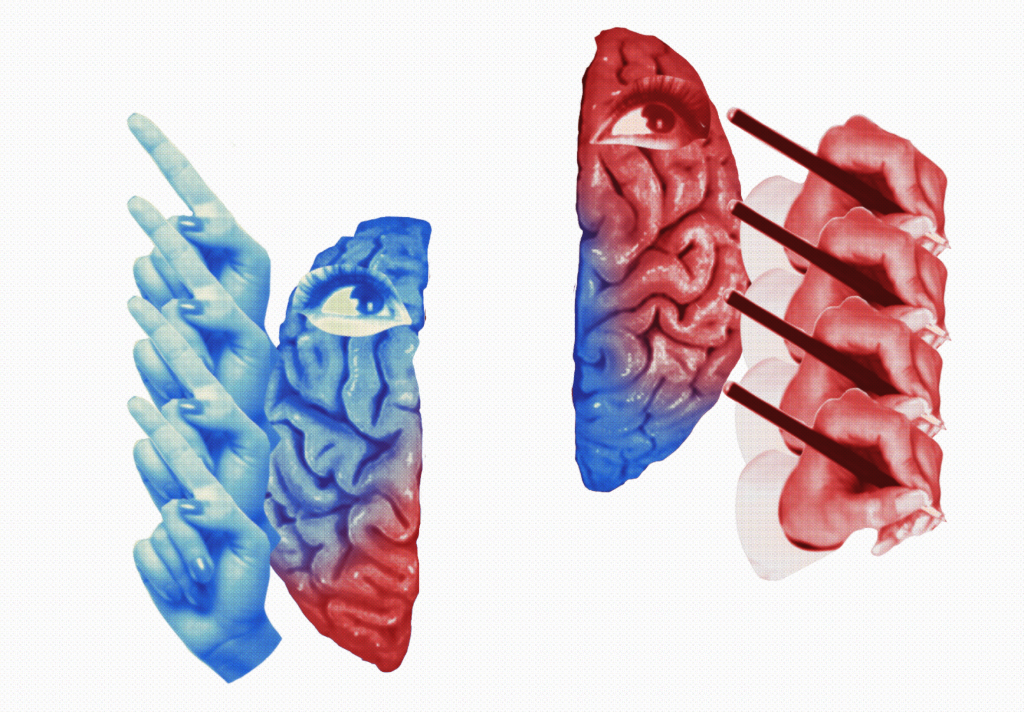
The Split Brain Syndrome is a series of side effects in patients who had their Corpus Callosum- the bundle of nerves connecting the two brain hemispheres- surgically removed. (Accardo, 2023) This procedure has been performed since the 60s in order to alleviate severe epileptic attacks. Studying Split Brain patients revealed some interesting things about the brain. For example, the existence of Language Lateralization – the fact that language is produced almost exclusively in the Left Hemisphere. Also note that each hemisphere mainly controls the opposite part of the body: so Right Hemisphere processes input from the left hand and vice versa. Due to minimal language processing in the Right Hemisphere, when you present an object on the left visual field of a split brain patient, they won’t be able to name or describe it, but they will be able to draw it using their left hand.
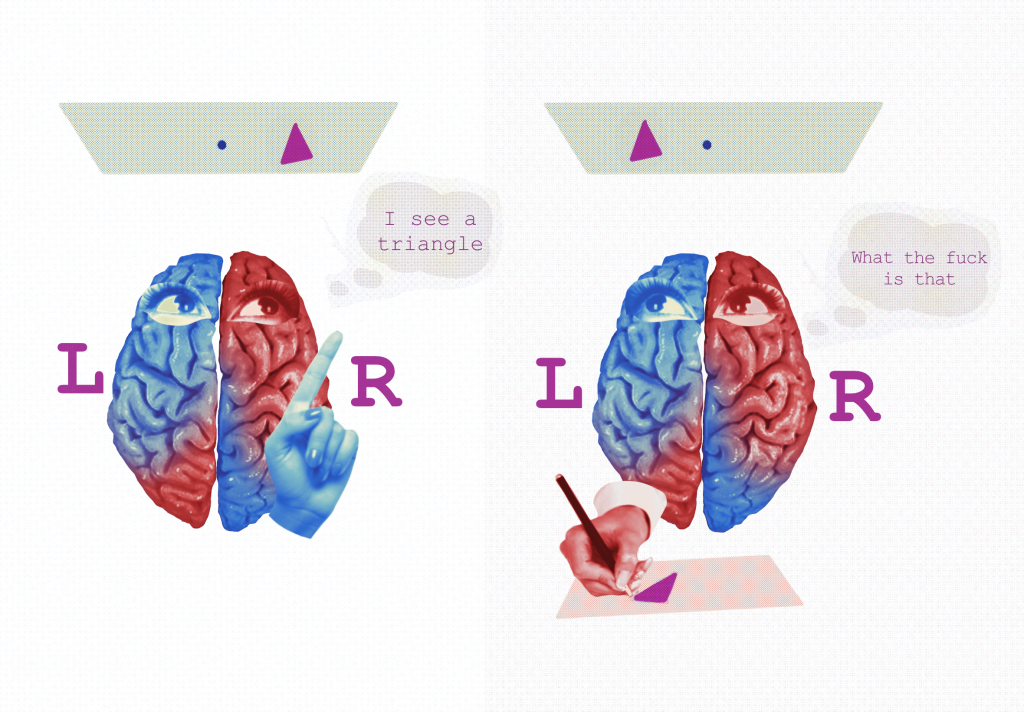
The information is present in both hemispheres, but due to the separation, the two sides cannot exchange their specialized capacities and skills to communicate said information.
Personifying brain hemispheres is not something I often do or recommend, but the scientist who led the Split Brain experiment did it before me, so I will take the liberty as well. The conclusion drawn from the first set of experiments on Split Brain patients in the 60’s was ambitious. Since the Right Hemisphere was able to process information “behind the back” of talking Left Hemisphere, it was hypothesized that this might indicate the existence of two separate consciences in the brain (Accardo, 2023). Right Hemisphere, this shadowed, mysterious second brain, whose desires and needs hide beyond the realm of language.
Of course, this is the conclusion you arrive at when you place language as the mark of “the self”. Why must every aspect of our being be contained within words? The Right Hemisphere hosts its own set of undisposable specializations, mainly memory and spatial awareness (Hartwigsen, Bengio, Bzdok, 2021). Is this separate from ourselves? Is it a “second conscience”?
I grew up as a left-handed child with a passion for drawing, being told many times the now-debunked fact that my creativity was a product of my dominant Right Hemisphere (UUHS, 2013). I think it was a way to somehow explain what remains so little understood: where does artistic “talent” come from? It must be stored in the illegible Right Hemisphere. This explanation has somewhat alienated me. After all, I had this compulsion to draw that I could not really explain to anyone, nor put into words. I just did it and accepted it as an integral part of myself. Neither I nor the Split Brain patients ever considered that their “self” was separate in any way.
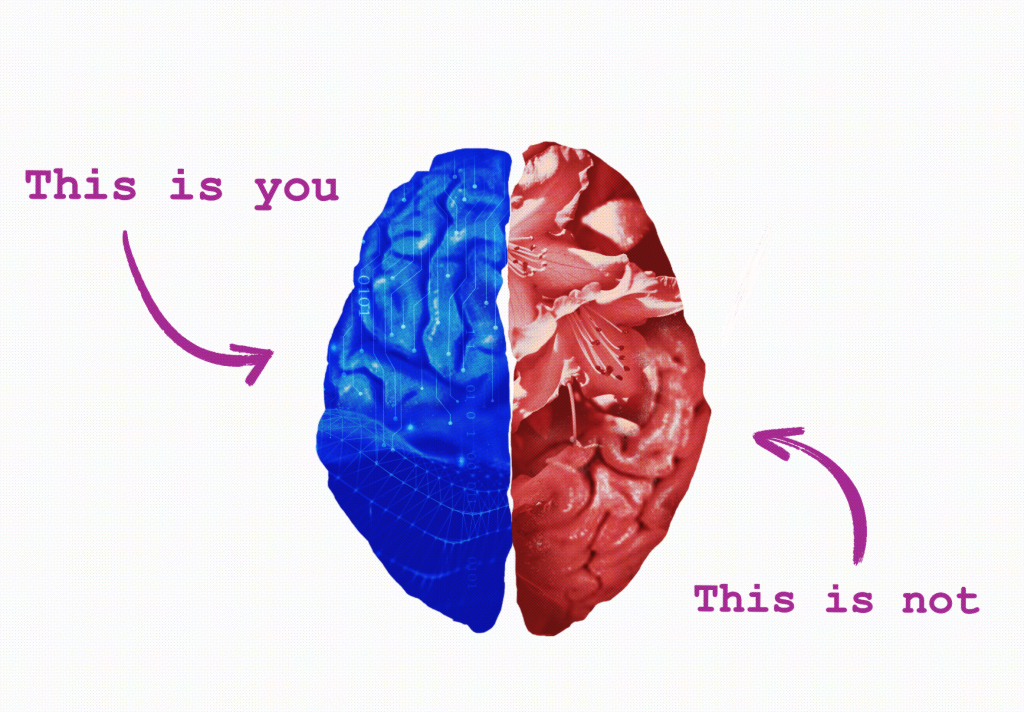
Art was not so much something I did as it was the way in which I was processing the world around me. In its beginning stages, art is hardly intentional. In kindergarten, I had a revelation when I accidentally discovered that red and white paint create pink paint. I did not know I could even mix colors. And before the artist mixes different styles and ideas, before the artist actively uses their tools in unexpected ways, most artistic innovations arrive like that, through uncontrolled occurrence. Experimentation is not art expressing the world, but rather the world expressing art.
Digital art programmes started off as an endeavour to simulate those processes. But this time, the world influencing artmaking was built from the ground up. There was a dialogue where programmers needed to understand and reply to artists’ needs. This is how technologies that replicated traditional artmaking, like pressure sensitivity and brush customization, took place. In response, artists gradually adapted to the new interface, features and laws of this new canvas. This feedback between artists and developers has led to great results, digital art no longer merely imitating traditional art, but coming with its own innovations and quirks that aid creation.
I would compare this feedback process to Taylor Eliot’s theory of cultural production. In his essay ”Tradition and the Individual Talent” (1919), he uses a dialectical approach to discuss how tradition and innovation are intertwined. Mark Fisher summarizes it best:
The new defines itself in response to what is already established; at the same time, the established has to reconfigure itself in response to the new.
(Fisher, 2009)
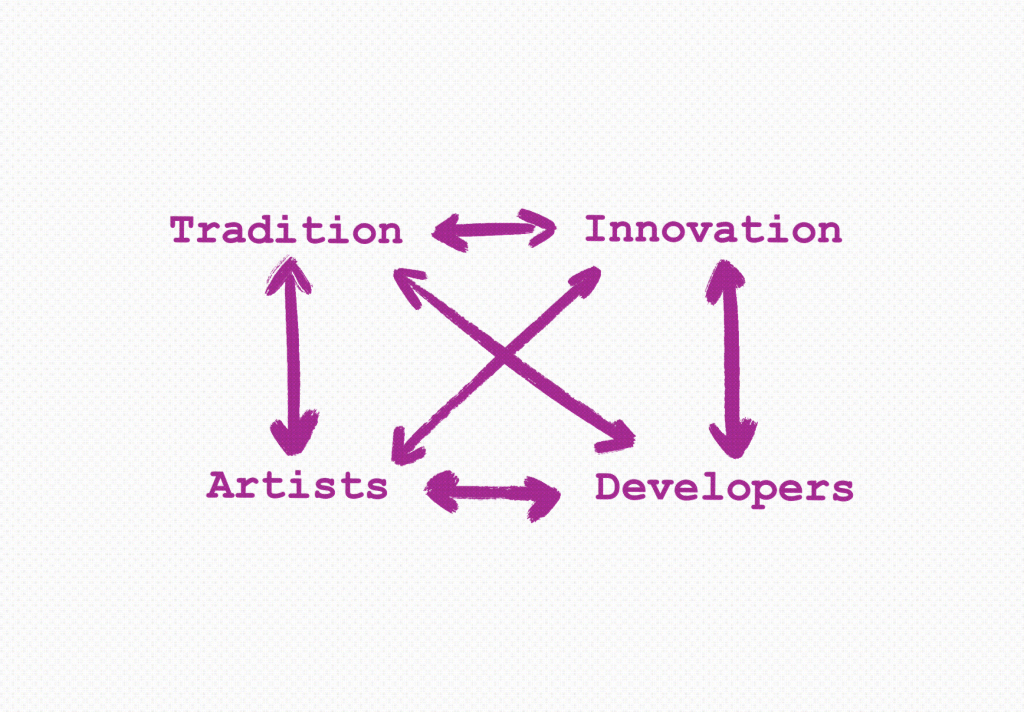
Mark Fisher opens his book “Capitalism Realism” (2009) by discussing this relation of old and new within culture. How does a culture look without the new, and how long can it survive? The reason why Fisher asks those questions is because he believed that capitalism, as it exerts itself into art creation, erases those connections and thus art itself, the old and the new becoming one artefact to a null context, everything and thus nothing.
“Eliot’s claim was that the exhaustion of the future does not even leave us with the past.”
(Fisher, 2009)
According to Marxist theory, capitalism manifests itself as this over-consuming entity that flattens every other category and system under the rule of the market. The knife that cuts the connections between art and technology, between tradition and innovation. Fisher proposes “capitalist realism” to describe the everyday experience of this manifestation.
So how does capitalist realism fit into digital art? Fisher discusses at large capitalist realist art through the perspective of the viewer (or rather, as he terms it, “consumer-spectator”), and I will look at it from the perspective of the artist (or, perhaps, the “content creator”).
Possibly the biggest innovation of digital art was that every mark made can be rehashed, removed, warped and so on. This paradigm reflects what Walter Benjamin discusses as the shift from aura to replicability in modern society (Benjamin, 1936). Replicability is there in the very act of creation in the case of digital art. The act of modification becomes the act of replication in itself: the original artwork is seldom really changed (be it due to multiple layers or previous saves), just endlessly multiplied, each iteration representing a new command. Here again, there is no “past” and “present”: the digital canvas exists in its entirety only as what Fisher calls a “bi-polar oscillation” (2009) between both.
So why does this happen? Does it benefit the artist or the programmer? It serves them both only as much as it allows them to serve the market better. As Mark Fisher might argue, capitalism has imbued art with limitless creation, devoid of physical limitations through the digital shift, democratized in its accessibility, and yet it constrained those liberties to the purpose of creating capital.
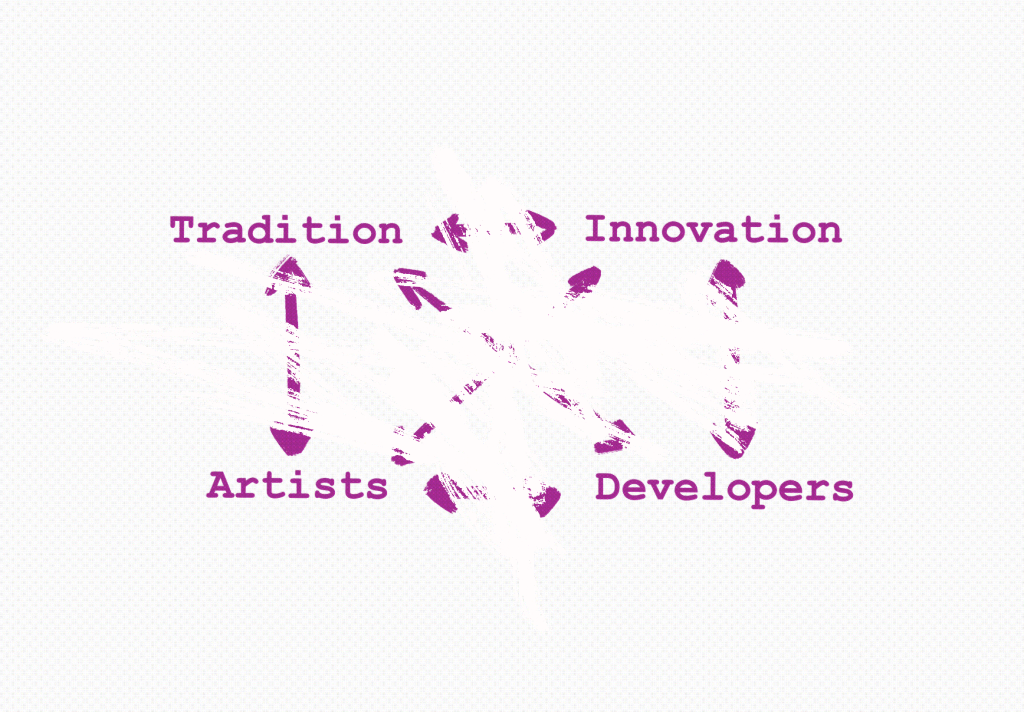
There is a very clear example of this in my experience with software evolution. As a professional artist, you usually present a work of art to a client, knowing they will demand changes. Oftentimes, the client is not aware of the process behind their product, so the changes demanded are almost absurd. Animated film specifically runs on a tight pipeline: you “lock in” the storyboard, the characters, the style, and only then, when all elements are conceptually clear, you may begin animating them. Animation is perhaps ironically not something to “fix in post” or at least not without huge time sinks. But in recent years, more and more softwares are relying on features that circumvent this process: using “non-destructive editing”, that is, processes that do not alter the original artwork and can be endlessly switched and modified. Think of Vector Art, which is built from mathematically-calculated lines that can be perpetually reorganized, and of Raster Art, which is composed of pixels that eventually alter the quality of the image with each modification. Vector Art is the feature that skyrocketed the popularity of the animation program ToonBoom, in contrast with raster art-based TvPaint. In 3D production, linearity is basically extinct: objects are built through modifiable effects and keys. Animation itself, ontologically movement of shapes through time, is done by modifying location parameters on a timeline. 3D films are, theoretically, all code, and if you wanted to change anything at any point in the production, you could.
“Endless possibilities” is the motto of digital software development. Art is considered to be limitless freedom because it looks like limitless freedom. But art is a system of understanding the world, and without rules, the artist can no longer make sense of it. In my own practice, I notice that when I use “dumber” software, I am more pleased with the final work. When all the other rules dissipate, the artist either has to create their own or they will be left to absorb the only laws remaining, those of the corporate market.
It would be disingenuous of any artist to deny that non-destructive editing saves a great deal of time. But is it the artist’s time that is saved, or the client’s? Is the extra time allocated to improving the art, or the market?
The increasingly feudal ways in which companies like Adobe distribute those tools that supposedly “democratize creation” only cement the fact that the tools were never truly made for the artists, but rather that the artists are made for the tools. All of the radical potential of the collaboration between art and technology is lost when one faction is treated as a tool.
In the digital art industry (graphic design, animation, visual effects, videography, etc.), the clients are often marketers. Marketing is the ”creative” branch of a company’s structure, coming up with ideas for promoting the brand. The separation between digital artists and marketers seems to me even more ludicrous than the one between digital artists and programmers. If the latter represents the alienation of the artists from their tools, the former represents the alienation of the artists from themselves. The artistic process contains both practice (guided by momentary intuition) and theory (guided by reflected intention), but in the corporate structure, those tasks are separated, delegated to digital artists and marketers, respectively. This severance is damaging for both factions. Without practice, marketers are unaware of the actual possibilities of their creative work. Instead of looking at art, they turn their gaze towards other marketers, towards statistics, towards achievements as measured by the company. Experimentation, this occurrence-based reinvention, is basically non-existent when every idea is premeditated, packaged and sold before it can even take shape.
For digital artists, this creates what Marxist theory calls ”alienation”. The worker feels a harrowing, lonesome split when they no longer have control over their own labor. Every artistic product is void of the inner emotion, ideas and individuality of the artist. Just like with the Split Brains, it is as if the thoughts and feelings of one side are assumed to be non-existent in the other. When marketers are the “client” in this exchange, the artist remains the executor of ideas that do not align with their own thoughts of values, even on an aesthetic level. They have to regurgitate a style that is already in the branding strategy of the company, or that generated somewhat statistical impact, or that the marketer – sometimes completely devoid of this aesthetic eye – thinks would work. I have had fellow digital artists tell me many times of clients that request a trending style or technique, even when such style is incompatible with the actual company brand or when it is, from a technical standpoint, inefficient. The focus on the market in this dynamic needs no commentary.
For many years now, it seems like the role of the digital artist has followed this strange, alienating idea of what art is under capitalism. Programming provides the language, marketing provides the thoughts, and art-making is this mysterious, silent faction that makes it happen. This estranged hand that picks up what we want, even when we can’t name it. This “self outside of self” that knows and executes our desires without speaking, without questioning, without thinking.
The arrival and usage of Gen-AI technology comes as no surprise. AI is, by design, the ultimate capitalist realist artist. The epitome of a selfless hand, where words come in, and art comes out. Ever expanding, ever multiplying, ever changing. The only practice is the practice of words, the only limit is that of your imagination, and, of course, of the market. So how long will it be until this border is erased as well, until marketing is imagination and imagination is marketing?
In discussions with Gen-AI enthusiasts, when you raise the question of copyright, or artists’ labour rights, or unethical use, a common argument they raise is that “You are not mad at AI, you’re just mad at capitalism”. This has always rang empty to me. The two are inextricable by their very design. Capitalism has always seen art-making as a tool. Gen-AI is the (dis)embodiment of the aesthetic logic of capitalism. And until those connections between artist and programmer, between tradition and innovation, are reclaimed from the market, Gen-AI will continue to be what we know it to be now.
Experienced animator and friend of mine, Tuan Nini, once wrote: “It is ironic that back when things took longer to make, you actually had more time to think. With all those tools that make creating faster, all that time saved doesn’t seem to allow us slow thinking. […] The more we try to save time, the more we lose it.”
According to Fisher, in capitalist realism, all time will be essentially lost. Art, with all its innovative potential, will reach a final impasse, running out of a past to respond to and a future to dream of. I believe we have not reached that point. And I stay optimistic enough not to think it possible. The human experience will continue to be expressed under any condition. But AI-generated videos feel like a glimpse into what Fisher’s reality might look like: already old and new, already intuition and intention, already everything and nothing.
I do not think AI is the end of art, partly because its inflated stock market value is already predicted to crumble (Cohan, 2025). It feels like the same gimmick that NFTs felt like. The other part of me knows that, somehow, the market will create an even more diabolical tool to replace artists with. But when those tools, as abstract and arbitrary as the market itself, cause real people to lose their livelihoods, I cannot help but feel nihilistic. When artists themselves place their own value on their capacity to serve the market, I cannot help but feel nihilistic. When we’re all tossed in this communal societal sundering, I cannot help but try to prove we’re still here even when we can’t hear each other. To reform those connections we once had, as long as we still can.
(Illustrations by Ștefania Bodescu)
Accardo, Jordan. 2025. “Split Brain Research: A Cautionary Tale of Sloppy Science” [YouTubeVideo: https://www.youtube.com/watch?v=aOsCwRsLAR0]
Benjamin, Walter. 1936. The Work of Art in the Age of Mechanical Reproduction. So Strand, London: Penguin Books Ltd.
Cohan, Peter. 2025. “AI Bubble May Burst, Wiping Out $40 Trillion From Nasdaq. Here’s What To Do.” Forbes.
Eliot, T. S. 1920. “Tradition and the Individual Talent.” In The Sacred Wood: Essays on Poetry and Criticism, 47–59. London, UK: Methuen.
Fisher, Mark. 2009. Capitalist Realism: Is There No Alternative? Winchester, UK: Zero Books.
Hartwigsen, Gesa, Yoshua Bengio, and Danilo Bzdok. 2021. “How Does Hemispheric Specialization Contribute to Human-Defining Cognition?” Neuron 109(13):2075–2090.
UUHS (University of Utah Health Sciences). 2013. “Researchers Debunk Myth of ‘Right-brain’ and ‘Left-brain’ Personality Traits.”