
Staircases
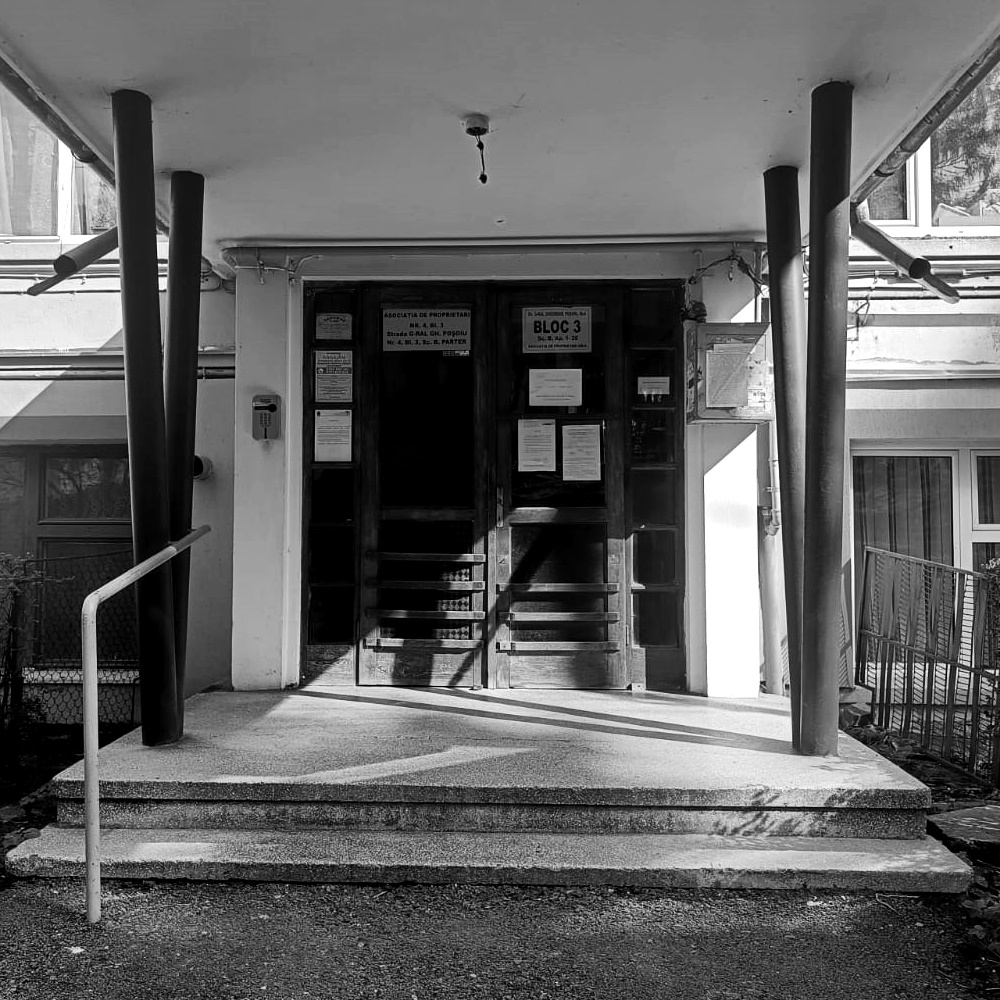
I remember the overwhelming sensation I felt when the heavy wooden door, reinforced with iron bars, creaked open. The scent of a damp cellar and stagnant water rose from the basement, carrying with it a wave of nostalgia. Bingham described heterotopias as “places where the stench of decay, the feel of dust, and the sound of fetid, dripping water not only serve a purpose but also create a sense of home for a group of like-minded individuals” (Bingham 2002:3). In my memory, this space is the staircase of an apartment building – an area of transit, both anonymous and familiar, through which strangers pass daily yet which does not fully belong to either the external world or private life.
The groaning wooden door serves as a threshold. The grey intercom, its green buttons worn down by time and countless touches, preserves, like a shrine, the names of past and present residents. The number I dialled to visit my father’s aunt was 12. Next to it were the initials D.I., her husband’s name, lingering there nine years after his death. This small device, meant to facilitate access, becomes an archive of individual history, intertwining personal memories with the quotidian. It is a “lieu de mémoire” (Nora 1989: 7) – a site where memory crystallizes and preserves itself.
The first thing that caught my attention upon entering was the row of wooden mailboxes, each overflowing with magazines, flyers, and bill envelopes. A neglected corner, an involuntary archive, a place where fragments of the past take root in the present. Having grown up in a house, my visits to relatives who lived in apartment buildings always fascinated me. Looking back, I now perceive a distinct two-dimensional contrast: the ambiguity of stepping into a stairwell, a space that precedes the actual home.
Each apartment holds a family, a person, or the memory of someone who once called it home. When we left my father’s aunt’s home in the evening, I remember shivering as we descended the stairs, waiting for the dim hallway lights to flicker on. At times, the night lights didn’t work, forcing us to rely on flashlights or the dim glow of street lamps outside. Walking like that, in the dark, I couldn’t ever shake the feeling that we were not alone. That space felt odd as if suspended in time. Human presence was the only thing that animated it, by simply passing through.
If a home is an extension of the individual, then the stairwell represents an extension of collective history – a ghostly architecture on which traces remain imprinted, like a time capsule. That very staircase seems frozen in time. People I knew when I was ten still live there.
I now reside in a ten-story apartment building that gathers even more people in one place, and paradoxically, I feel lonelier than ever, as Marc Auge underlined “spaces in which solitude is experienced as an overbur-dening or emptying of individuality, in which only the movement of the fleeting images enables the observer to hypothesize the existence of a past and glimpse the possibility of a future” (Auge 1995: 87). We have become increasingly detached from one another. The elevator has erased the act of flâneurism between floors – the chance to observe glimpses of personal histories woven into the fabric of this collective space. Encountering a neighbour is no different from crossing paths with a stranger.
In some buildings, the staircase still holds a sense of emotional resonance, shaped by the collective imagination. Each floor carries its own history, marked by the objects placed there. The last time I visited my father’s aunt, I couldn’t help but notice a painting of a girl who looked like Laura Palmer. It resembled a school yearbook photo – a faded blue background, wavy hair neatly styled, and lips painted in a faint pink shade. I never found out if she was a former resident of the building, or if she still lived there. I still wonder why her portrait had remained there untouched for so long. The staircase is not an inert backdrop – it is an active space where every object is imbued with its own history: a living museum of the people who passed through there. Over time, residents have left their imprints – paintings hung on the walls, rugs placed at doorsteps, small potted plants nurtured with care. It is also a non-place, a mere storage space for discarded objects that no longer fit inside apartments.
The stairwell shapes atmospheres; it is a space that cannot exist without a subject to experience it. It is a layered fragment of memory, embedded in the architecture of my past, a past which sometimes creeps up on me.
Bingham, Kevin. 2002. An Ethnography of Urban Exploration Unpacking Heterotopic Social Space, Palgrave Macmillan
Nora, Pierre. 1989. “Between Memory and History: Les Lieux de Mémoire.” in Representations, No. 26.
Auge, Marc. 1995. Non-places. Introduction to an anthropology of supermodernity, Verso, London