
Playing Outside
And this rain doesn’t stop. After countless trips back and forth to the window, still no one. I finally declare myself defeated by boredom and decide to go outside, no matter what. With my raincoat on, I drag on that terribly broken ball. I hope that someone will hear it shuffling against the asphalt. Perhaps they are lurking like me behind those cigarette smoke-soaked curtains from above, and they will join me. You know, like in those cartoons when the smell of fried turkey brings you, as a floating, closed-eyed, smiling dog by the nose. It’s so soft I can’t even kick it properly. I would rather hook it with the tip of my foot and throw it with a slap against the back wall of the grocery store. There we drew a proper goal with white chalk, so we can play the game ”twenty-one”, where the ball must not hit the ground. We could also use the carpet beater, which has real crossbars and it’s like the goal proper size, but it’s not always free there, as the older boys have priority. But here it’s our spot. Just like Steaua FC, who won the European Cup last year in ’86, we even play official games when there are enough of us to make two teams, with numbered T-shirts and all. Still, we have to make the opposite goal from two big stones, I know, it doesn’t have crossbars, so we always argue when it’s over the post. As I’m about to give up on this poor ball and bitter rain, I hear Mihăiță jumping three steps at once from his bloc’s staircase. ”Man! Give it a pass, will you?”
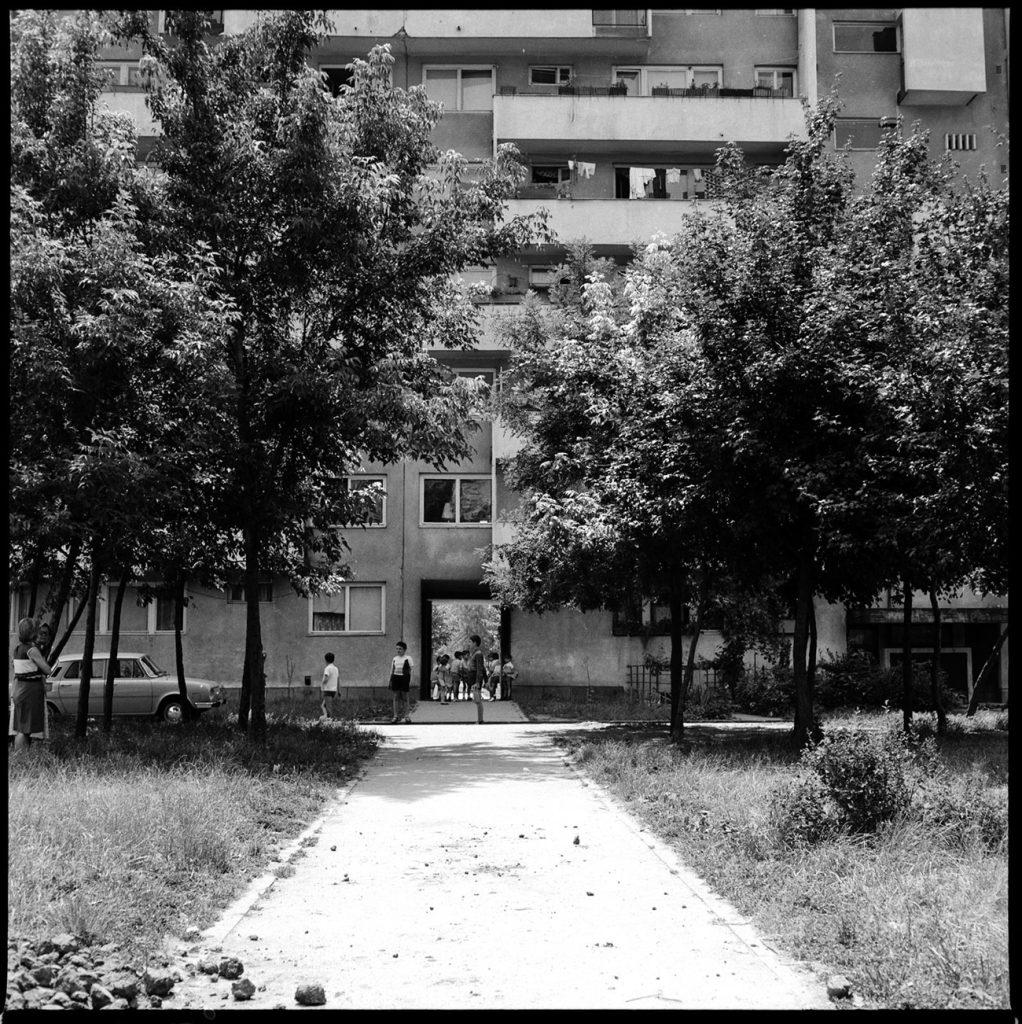
Children’s self-organised play was one of the main informal activities that took place every day in the generous open spaces between the blocs. Especially during socialist time, certain games developed more in this context and even grew specific to it. In the absence of formal playgrounds within their reach, large groups of children living in the same apartment buildings and sharing the same courtyard spent a lot of time “outside”, in front of their bloc. With their parents gone to work, which in factories sometimes meant working in shifts, including at night, many of these children were left at home on their own after returning from school. With “the key around their neck” they went out together and played all day. Thus, play by the bloc was an inherent collective activity, highly creative and carrying an exploratory dimension. Any piece of infrastructure, however small or insignificant, could be interpreted and reused to support children’s imagination and their games. The bloc’s staircase, the gangways, the carpet beaters, the fences, the construction sites, the stores’ warehouses and the street in general lost their utilitarian role and became playground infrastructure. Kids didn’t just stay in front of the bloc all day, but from time to time, they went on truly exploratory adventures around the edges of the district. The collective housing district became one huge playground. In time, generations changed, children became teenagers and didn’t play street games so much during post-socialist times, perhaps except for football, which was defying any age stereotype. Although the parks or the boulevards became new destinations, teenagers didn’t completely leave the bloc’s proximity and kept hanging out around the same places. Thus, the street was a space in a continuous negotiation between them, other kids’ groups, the increasing number of drivers parking their property and the neighbours, more or less tolerant to their use of the shared spaces.
Many of these games and the experiences recollected by the children of those days were surprisingly similar across the country. It is possible that their wide occurrence was achieved by the children’s enrolling within the state’s system of summer camps, schools, kindergartens and sport clubs, where some of these games were taught by sport trainers, following formal guides and rules. Once returned home, children continued the informal play of these games, sometimes twisting their rules and adapting them to the in-between spaces of the districts. Adopted on a wider scale, they were in fact enacting children’s specific ways of taming the territory, occupying it, hacking it, while negotiating with other various groups, from other groups of kids to adults. The games were creating and maintaining invisible boundaries, establishing ad-hoc rules and training them into the practice of social interaction and constant negotiation. Transferred from generation to generation and developing some regional variations as they were responding to local specificities, they, however, amounted to a true practice of living, specific to the socialist city.
One of the most complex activities was street football, which was played in all kinds of formats and places, from games on leftover spaces by the district’s edges, to more technical and static ones specific to blocs’ concrete courtyards, or even to proper football games in the schools’ sport fields outside their schedule. Football included a high level of explicit self-organisation and constant negotiation. In the same way, potentially as a result of some formal activities initiated by the sports teachers from the district schools, such as local championships or trials for the sports clubs, the children took over and continued these activities on their own. This phenomenon was so widespread that it appears in many films of the time, such is Duminică în Familie/ Sunday in the Family (1988), directed by Francisc Munteanu, where a love story between Alexandru, a distraught computer programmer and Oana, a young architect who takes care of her siblings, unfolds in the context of collective housing, illustrated by the Drumul Taberei district. The film starts with a heated dispute among the children involved in a football match between two major districts, which was settled by the adult programmer, who thus becomes acquainted with the sibling of his future wife. The match is treated very seriously by the children, who are self-organised, have equipment, negotiate the rules and play on a rather generous football field near the local school, equipped with proper goals and encouraged by spectators. Thus, the film illustrates a series of practices specific to life in the district, among which street football occupies an important role. Without just being staged for the sake of the film, street football was an important activity for many dwellers growing up between the blocs. Such informal championships between self-organised teams from different schools or even between districts were usual. Compared to the small games behind the bloc, these championships involved participants’ explicit organisation and the active sharing of resources. The kids improvised their own equipment, collected money to buy the ball, negotiated rules and even engaged in producing spatial infrastructure from leftover materials. Making the posts for the match could go from a simple chalk sign or a rock, up to sticking poles into the ground and connecting them with a net. They took the roles so seriously that some had a medical team for intervening in the case of an injury! Moreover, street football became more than a game, involving various groups, crossing social divisions and transforming the spaces of the neighbourhood. As one resident (N.E), a woman who was a teenager in the early 1990s, remembers standing in front of the now closed gates of a school from Drumul Taberei district of her participation into these special moments for the community:
“Everyone was coming. All the friends came, almost the whole neighbourhood came. They also have supporters, because they also came with friends, girlfriends, brothers, and sisters. You know, I was there to watch all the matches. It was just like a football game, except it was in the school yard” (N.E., resident).
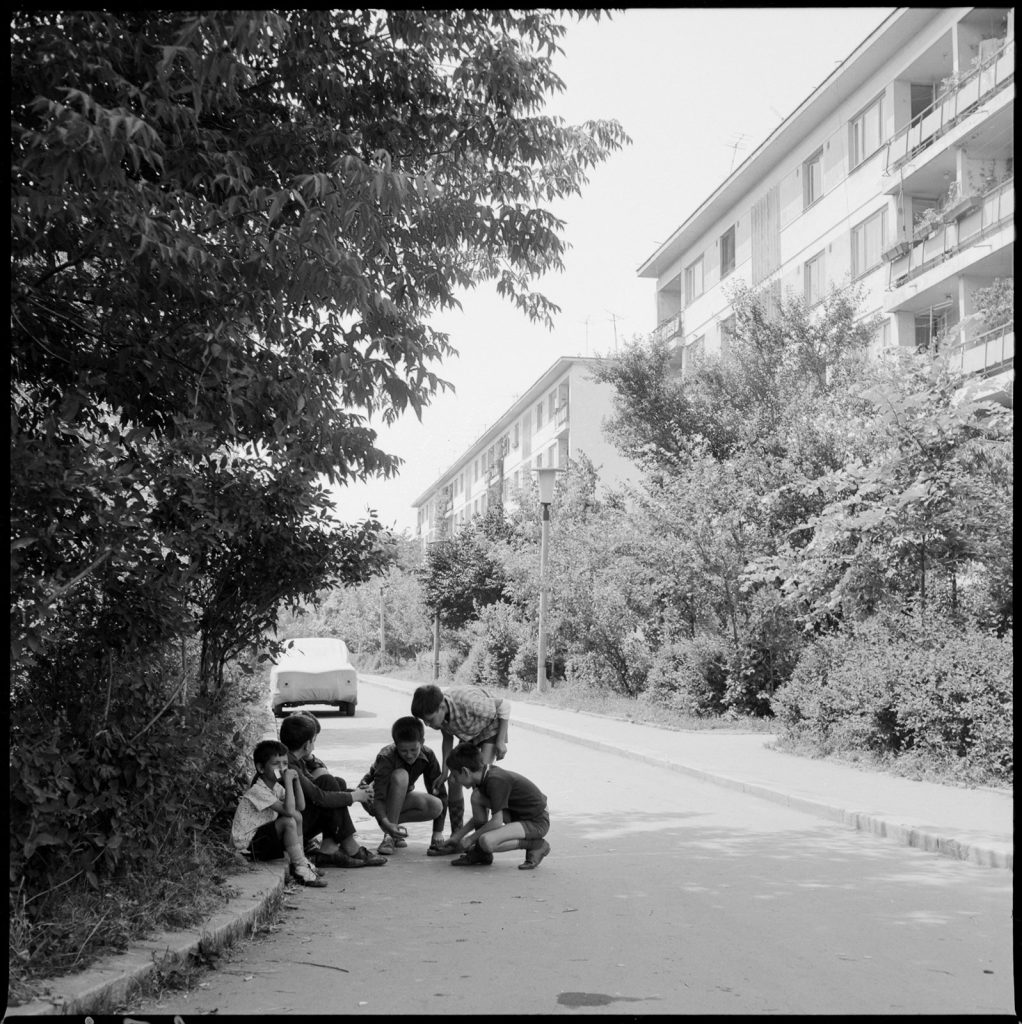
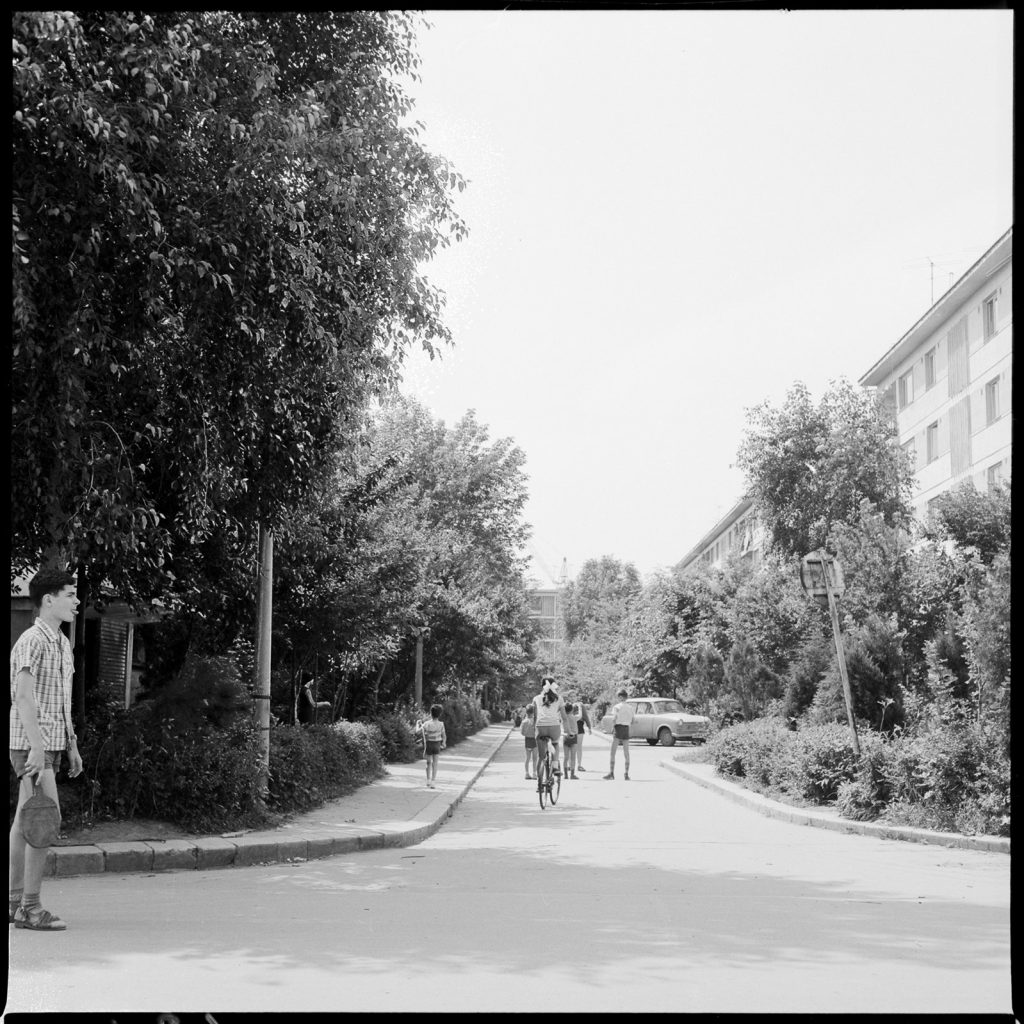
Football was part of an ecosystem of living practices of social interaction, spatialized and formalized through the game. In the movie De dragul tău, Anca! / For your sake, Anca! (1983), directed by Cristiana Nicolae, the illustration of a young girl, Anca, passing through an adolescent crisis is mirrored by the family’s move to a new bloc. In this context, street football works as a universal language, helping the newcomer to integrate, crossing social as well as gender stereotypes and barriers. Pursuing a neorealistic approach of recreating the universe of life by the bloc, we see ordinary people in ordinary situations in the bloc’s courtyard. Here, some neighbours have set up a garden while others are playing backgammon, while the children are playing around all the time and always in large groups. Both spatially and in terms of exposure, children’s play is still dominated by football, at least when the drivers are not chasing them away or the gardeners are not cutting their ball with a knife. Such scenes were usual, even in my own memories. The universe of living and playing by the bloc is quite authentically reconstructed in these movies and not purposely staged.
With the densification process, which started in the mid-1970s and continued in force during the 1980s, the reduction of the spaces between the blocs by adding new buildings was accelerated. Following the 1990s radical privatisation, the remaining spaces were occupied by more structures and buildings. Thus, one of the most affected categories of residents by these processes was the children. For them, these spaces were essential in the organization of street games. Still, some of them continued well into the post-socialist city of the 1990s. However, they have slowly died out following changes in the culture of living, including other alternatives of spending free time, but especially triggered by the physical occupancy of the in-between spaces by the wave of parked cars. Whatever remained was fenced, enclosed and claimed by other groups. Kids were contained in standardised playgrounds and parks, and the informal street play became almost extinct. Present mostly just in the memory of today’s adults, playing outside became, over time, an important ingredient for crystalizing the residents’ feelings of belonging to their neighbourhood and community. Moreover, as if testifying for their enduring capacity to mobilize not just nostalgia, but a real spatial practice,it was during the recent pandemic that residents from collective housing districts were forced to spend time around their buildings. Hanging on the few remains of that playing infrastructure, the residents rediscovered the practices of play specific to their childhood. Now, adults and parents showed their kids how to use the carpet beaters for gymnastics, or for hanging swings, they played street football between makeshift goals, and they drew together with chalk the asphalt among their parked cars. They rediscovered through practice the streets of their childhood. And this was again, a collective, shared, creative and disobedient practice. These games and the practice of playing outside in general were part of a larger relational web made of meetings, visits, birthday celebrations, mutual help, collaborative homework, food exchange and gifts among neighbours, which amounted to a practice of living specific to collective housing districts. Moreover, playing outside exposed its participants early on to an implicit practice of commoning, even without knowing it. The embodied memories of that experience were perhaps continued and expanded by some of them into other forms of informal practices of commoning, from community gardening, hanging out by the garages and active neighbourhooding in general. Even the memory of playing outside the bloc is still cherished and shared today by the former kids with “the key around their neck”.
(Extract from Discreet Commoning in the Bloc: Informal practices of ‘living together’ in the collective housing estates of post-socialist Bucharest, PhD thesis, University of Sheffield, 2024.)
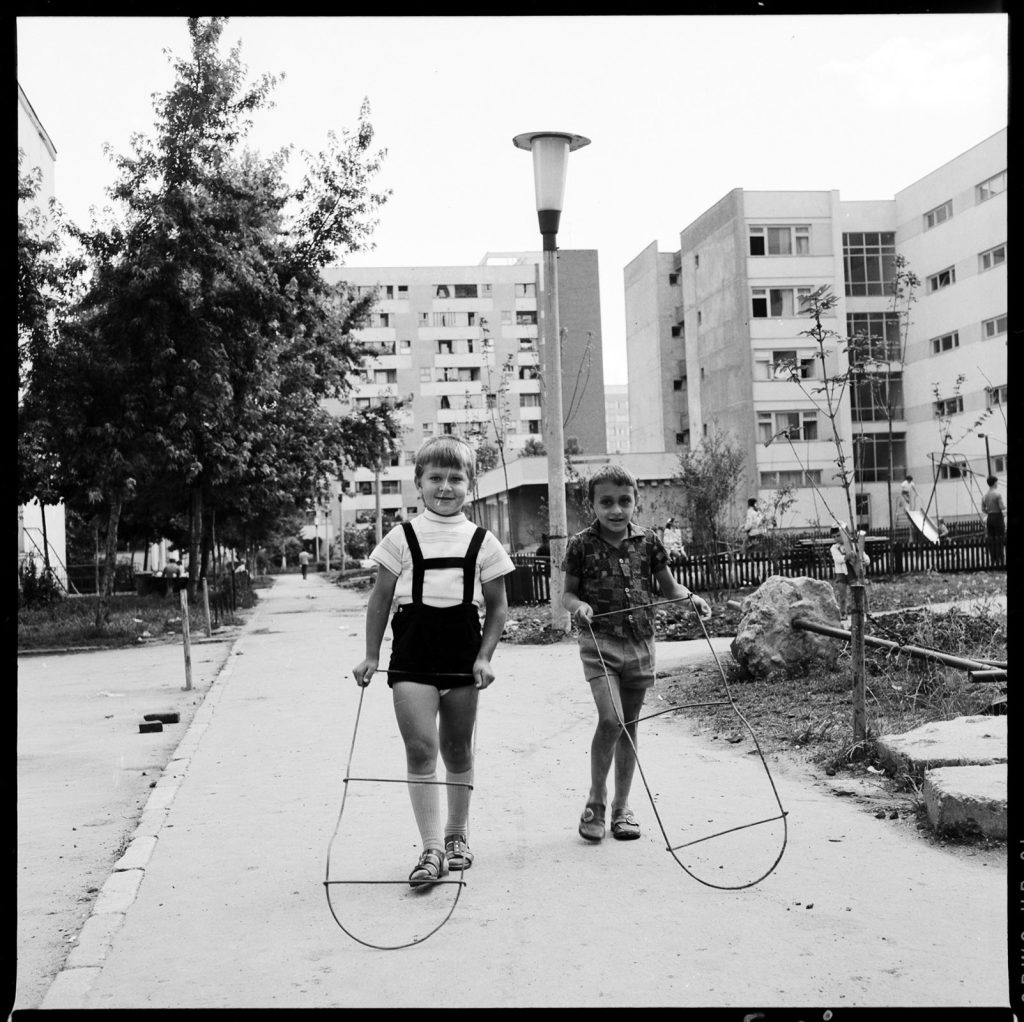
(Photographs from The Drumul Taberei Monograph, 1973, from the Mihai Oroveanu Collection of Images, courtesy of Anca Oroveanu and Salonul de Proiecte, www.photopastfuture.ro.)