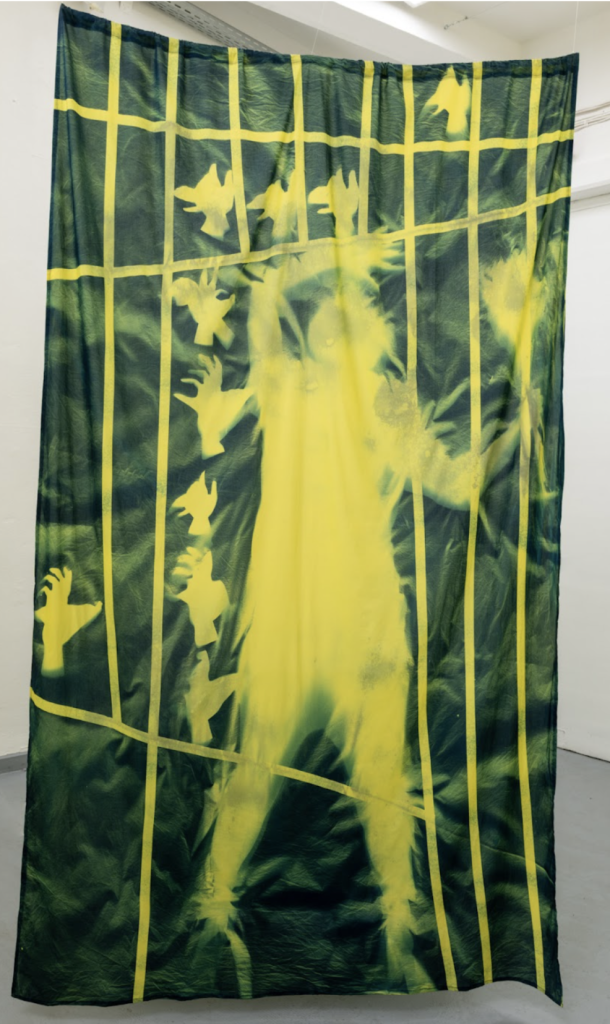
Shadow be still. Thoughts melting in the sun
(Humming, building up courage or dispersing the awkwardness of talking by myself.)
In the top left corner of one eye, I see something like a thread. It could also be some tall grass, but I can’t be sure. The image would be clearer if I turned my head a bit more, but I’m afraid to do that. Better lie still. The sun is so strong that the rest of my vision is already blotchy with neon yellow spots. I close my eyes and try to follow one spot, but it moves whenever I try to place it in front. I open my eyes again. From this position, all I see is the retina-burning sun and the sky, so clear it’s almost white.
Something is crawling up my thigh, or maybe it’s just my imagination in expectation of something to be crawling on me. It’s not the first time I’m doing this, but it feels like the hardest one. Each time feels like the hardest time, but this time is the hardest. There were times when I listened to music or podcasts, and two wonderful times when I had friends keeping me company. But now I’m all on my own, counting seconds and my thoughts while passing through them. My left shoulder is painful, and I worry how much of the sweat that is already covering my body will infuse this textile I lie on, how will it affect the image my body is writing onto this surface. Nothing is moving except for my mouth, talking aloud so my phone records some of these thoughts. I wonder if this is making time move faster or slower… This damn shoulder turned from painful to numb which is even scarier, because I know how painful it will be once I start moving it again. Better postpone and focus on the matter at hand. There are several things crawling on me by now, I’m probably still very far from the sound of the 30-minute alarm, and I worry this might turn into a double failure – all this blabber will not add up to much, and the cyano print will be blurry. I’m already out of ideas, so I’ll start counting my breaths now.
(Several breaths pause.)
I switched from counting breaths to counting needles, the needles in my left hand, which are making me go almost mad at this point. I try to separate them, make space around each one and see them as isolated violent events that pierce through my skin. One, two, three, four… I can even choose the next place where a needle will pierce. My left hand, full of holes by now, feels very, very far away. Not even sure if it is still connected to the rest of my body. I have turned into a character from a painting by Tarsila do Amaral, hips large and heavy, rooting me into the ground, head up in the sky next to a caricature of a sun, cacti arms of different sizes, acres away from the torso. One of the bugs was fooled by my newfound roots and is nibbling at my skin.
(A lot of needles pause.)
It’s too many, I lost count. The feeling of pins and needles on one’s skin is called paresthesia, and it can appear with or without any apparent cause. It’s also something that everybody feels at some point in their lives. Funny expression, pins and needles. As if the skin is a piece of fabric keeping together all the other organs. Like a pillowcase. I was shocked to learn the human body has 78 major organs. I could count 10, maybe 1, 2 before I looked into this. Maybe I do see myself as the simplistic yet so mesmerising character from Abaporu, Amaral’s painting that inspired the Anthropophagic movement (from “anthropophagus,” meaning “feeding on human flesh”). My bug agrees, human flesh is tasty. The metallic taste in my mouth turns sweet for a moment, and I can feel the sudden production of extra saliva. “Tupi or not Tupi”. My mind covers vast territories and times, but my shadow does not flicker; her job is to stand still. We’ve been together for a long time, but only recently did I decide to name her: Paresthesia. She precedes me in time, even when she succeeds me in space. She learns things before I do, and I suspect she’ll walk the surface of the Earth long after me. After all, she’s made of surface, a continuous surface, always in two dimensions, stretchable beyond the horizon. When the sun is strong, she turns into a cut-out from the landscape. A missing block of information, pure non. Both she and I, especially when zipped so close together, could be hidden in one of the paintings from Margaret Atwood’s “Death by Landscape”.
(Grunting pause. I could not resist the temptation and moved my left hand very slightly. The needles turned into sharp pain across a hot wire connecting the middle finger to a nerve at the back of my neck.)
There’s also this story of a young woman who suddenly falls ill and becomes more and more disconnected from her family and fiancé. One day, out of nowhere, she plants herself in a large pot and immediately starts feeling better. The soil is up to her hips, and she feels content and healthier. Everyone around considers this a form of madness and tries to make her come out, to no avail. She remains silent, feeling like she’s slowly becoming “the center of the world, the source of its movement”. Gradually, she transforms into a tree, and though her fiancé marries another, he plants her in his yard, where she lives contentedly long after everyone she ever knew has died.
To let my flesh be eaten and grow roots, just to make my shadow be still. How much can one sacrifice for the sake of a good image?
I am (still) lying under the scorching sun, wondering how much time I have left. I want this image to turn out right, but also to find something worthy of transcribing in all the gibberish of this sound recording. I remember another story, one by Michel Tournier, about a female photographer. Obsessed with the perfect body of a young model, she turns him into the sole subject of her art. Dissatisfied with the inaccuracy of conventional photography, she begins to embalm him in photographic solutions, effectively turning him into a living photograph. A permanent, unchanging image that aims to capture beauty by killing it. “In her madness, she believed she had captured eternity, not realising that she had destroyed the very essence of life she sought to preserve. Alexandre was no longer a man, but a memory encased in a coffin of chemicals.” Nature morte humaine. Am I always this macabre, or is this just the pain speaking? Or maybe I just felt like I should mention where this full-body-cyanotype idea originates from.
(The bug is up my sweaty crotch by now. My muscles spasm like a horse or a cow’s, trying to get rid of flies. The attempt seems successful for a brief moment, after which the bug resumes its nibbling in the newfound spot.)
There’s another work that quotes another work and ends up reflecting on the body-landscape relation, in a very beautiful and sensual way. Quoting a work by David Hockney, Miranda July herself steers the driving wheel of a car through the canyon depicted in Hockney’s painting while being seduced by a lover on a video call. The inability to fully engage with the image (‘keep your eyes on the road’ the other woman says playfully, while undressing) makes the protagonist project the body of the one she desires onto the landscape her own body moves through, resulting in fleeting glimpses of mysterious women by the side of the road.
(The alarm goes off, but by now I’m kind of enjoying myself, or I feel like there’s more to say, so I wait patiently for it to stop in order to say a few more words.)
I almost forgot, I wanted to make a list of the things that will leave a mark on this textile surface: saliva, sweat, tears, cutouts of hands creating shadows that suggest animals, long strips of scotch tape that should organise the canvas into a grid of some sorts, a bouquet of dry plants I collected last year from an abandoned copper mine in the Apuseni mountains, and an inexact shape of my body, the pet shadow I now call Paresthesia. Everything hurts, but I can move now, so why don’t I? Maybe I’ve set this as a trap for myself, and not just my shadow.
(I stay lying for a couple more minutes, after which I jump up and start folding the cyano textile to stop it from further exposure. I am covered in sweat, my head is spinning madly, and the sparkles in my sight intensify. I find a precarious balance while sprinting away with the cyano, which needs washing in the dark now.)
1Death by Landscape”, Margaret Atwood, 1989
2“The Sleep of Plants”, Anne Richter, 1967
3“Le Nain Rouge”, Michel Tournier, 1975
4Nichols Canyon Road, Miranda July, 2020