
Part XXII: The Janus
The following text is a chapter from Măiastra: A History of Romanian Sculpture in Twenty-Four Parts, a work of fiction written from the perspective of Prof. Igor Gyalakuthy, and supplemented by the professor’s daughter, Ana Maria Jderiou, also a fictional art historian.
This is Ana Maria on Romanian art history post-1990.
Despite the best efforts of the Romanian People’s Republic, modern art has existed in this country without interruption since its conception. From the early 1950s, Romanian artists were using experimental visual forms to push against the aesthetic isolationism of the pre-Glasnost decades, and to converse with artistic movements occurring in the West. In the sixties, in Timişoara, the Sigma Group was taking a collaborative, interdisciplinary approach to its neo-constructivist utopianism. In Arad, Kinema Ikon were exploring an auctorial, structural relationism through experimental film. The 1970s and ’80s saw artists like Ion Grigorescu surreptitiously developing strategies of opposition, bringing his brand of impudent conceptualism to the public eye only after 1989. By the mid-1990s, there existed a vibrant community of artists and thinkers for whom a reverence for Romania’s subterranean art historical past, and a distaste for its state-sponsored propaganda, came baked into their visual affinities.
The emergence of a Westernised sociopolitical discourse that followed the Revolution thrust contemporary art into the spotlight, and sparked a debate amongst scholars about how best to establish a new Romanian art, one that embraced the critical autonomy of the modernist movements of the sixties without reinforcing the autochthonous spirituality that plagued Romanian art in the twenties and thirties. Two exhibitions demonstrate with particular fidelity the emergence of a new epistemological modality for the future of this country’s visual culture: a state of advancing in reflection.
(The second essay is an abridged version of a review I wrote for Arta magazine in the year of the exhibition.)
subReal, Alimentara, @ Orizont Gallery, Bucharest, February 1991
In 1991, the main exhibition space of Orizont Gallery was disgusting. The air smelled strongly of urine, the paint was peeling, and the plaster was crumbling off the walls. The ceiling looked as if the entire floor above was leaking brown water. Walking into Alimentara, I first noticed a pyramid of stacked glass jars against a long white wall. The jars were filled with pickled vegetables, a familiar feature of most Romanian households during the food shortages of the 1980s. Tightly packed and drowning in dark brine, these pickles were symbols of the unavoidable preservation of trauma and, like that trauma, were imbued with the menacing potential energy of bomb shrapnel. Nearby, a collection of empty wine bottles on the floor, a pork bone hanging on the wall, and a dilapidated refrigerator in the corner. The sculptural installation was the work of subReal, an artist collective formed in 1990 by artists Dan Mihălţianu, Iosef Kiraly, and art historian Călin Dan. For more than thirty years now, the group has focused on a spatio-cultural examination of Romania under communism, utilising performance, installation, and, most effectively, archival photography in order to examine this era’s influence on contemporary Romanian culture. subReal’s ophthalmic archaeology is especially potent when examining the aesthetics of Ceaușescu’s cult of personality, and when re-intentioning the resultant artefacts in order to educate, subvert, and, most critically, to preserve.
Named for the state-owned supermarket chain, infamous then for its impossibly long queues and scant food, the exhibition’s intention was to “serve” the international community a taste of quotidian Romanian life under communist rule. Here, though, the romantic notion of art-as-nutrition is undercut by the truth of this particular grocer: if you came for any kind of nourishment, intellectual or emotional, supplies are limited. I was young enough at the time to wonder if any of this constituted “high art,” and if the replication in a dingy room of some of the grimmest scenes from my parents’ lives, and indeed my own, was transcendent, or just sad and somewhat cruel. Whatever it was, it was funny, and I remember the self-conscious giggles of the older gallery visitors as they saw the rotting cabbage heads piled up on the refrigerator floor. The found-object structure of Alimentara enabled subReal to reference the Dada movement’s Romanian roots while adding just a pinch of self-deprecating Balkan mischief: Duchamp’s bottle rack may have been just a bottle rack, but at least it was French.
In his catalogue essay, Zoran Eric described Alimentara as the experience of mourning, and in a way, it was. But more than grief I felt embarrassment, as though strangers were thoughtfully examining my underwear drying on a clothesline. Remember, this is only two years after the Revolution; chaos still reigned in Romania, and any real processing or healing had yet to begin. The shame shared privately among Romanian families was now being presented publicly, and framed as darkly comic fare. This shame comes not from our history itself—being the victim of a crime is nothing to be ashamed of—but that the experience of being Romanian now is tied inextricably to the destabilising confusion of those years.
Even now, I carry with me the oneiric sense memories I collected at Orizont: the smell of fried ham (the result of a performance in which visitors were invited to cook a food representative of the time), the sounds of blushing laughter, the sight of those ominous pickle jars and the realities contained inside them. There were warnings that the path forward is lined with painful reminders of the past. Alimentara clarified this feeling in me and gave it its own separate jar.
Geta Brătescu, Apparitions, Romanian Pavilion Venice Biennial, Curated by Magda Radu, 2017
Take my hand. This is the invitation presented to viewers of Les Mains, a short black-and-white film shot by Georgeta Brătescu in 1977. In the film, the camera zooms gently in and out as Brătescu’s hands move hypnotically across the screen. The sole protagonists, these two hands shift between rapid, performative gestures and mechanical actions exercised on everyday objects: a glass, a sheet of lined paper, a wedding ring. They leave the frame only to bring a lit cigarette to the mouth of their anonymous manipulator. The longer they play across the screen, the more the hands seem autonomous, possessed by their own curiosities to paw, fidget, and probe. Yet the genius of the work is that somehow, the truth is never out of reach: these are the waxen, muscular hands of a woman, invigorated by work and hardened by experience.
If we accept the invitation and take these hands as substitutions for the artist herself, then the frame of the camera lens represents the walls of her atelier, a room that would come to define Geta Brătescu’s entire career. “The studio is myself . . .” she wrote. The significance of a private room is familiar to anyone who has lived under tyranny, a miniature realm where safety and liberty merge into the same illicit idea. Not wishing to devour this precious space, Brătescu focused on drawing, her primary weapon, as well as textiles, collage, and filmmaking, mediums that kept her work from overflowing out into the streets. She was an artist covetous of the interiority of the writer, and of the imperceptible micro-culture of the poetic universe. Here, ideas are artworks unto themselves and require no further manipulation. It is in this cranium-sized room where Brătescu felt inspired, hypnotised by the marks moving across the pages, imagining them as dancers, imagining the sovereign lives of each geometric shape cut from each scrap of colourful paper.
Shrinking is often viewed as a form of capitulation, but minimisation can be a method of preservation. For a younger generation largely unaware of the dangers of making art under tyranny, Brătescu’s career has become a blueprint for how to live an artistic life without succumbing to the violence of confrontation, and the distorting impact that confrontation can have. In her older years, her hands had paled and shrivelled, no longer the muscular instruments of a powerful draftswoman, a change she was keen to capture in her drawings. A series of these drawings forms a part of Geta Brătescu’s Apparitions at the Venice Biennial (2017), the first solo exhibition by a woman in the history of the Romanian Pavilion. Venice is often dominated by headline-grabbing installations, so it was a relief to walk through a quiet collection of works on paper that, on the surface at least, presented no grand curatorial statement, simply the long-overdue exposure of one of Romania’s most important artists. Yet by selecting an artist like Brătescu to represent the country on an international stage, curator Magda Radu hints at a model employed by the Romanian arts community since the 1990s.
Undeterred at ninety-one years old, Geta pushed forward, refusing to be defined by narratives surrounding art under communism, or under any other power or pressure exerted on her at any moment during her long career. Not a life of resistance, but a resistant life.
Two eyes stare fixedly at the horizon, while two more guard the moments in the past when art embodied the dignified and defiant aspects of the Romanian spirit. This is the Janus, goddess of transitions, a parallax at the core of some of the most powerful art made in Romania today. It’s a clumsy way to walk, to be sure, and there have been and will be stumbles and false starts along the route. A reverence for the past runs the risk of discouraging new generations of artists from sprinting untethered into the future. Yet there is grace in this clumsiness, something my father believed, in the cautious deliberation required to walk surely forward without falling irrevocably back.
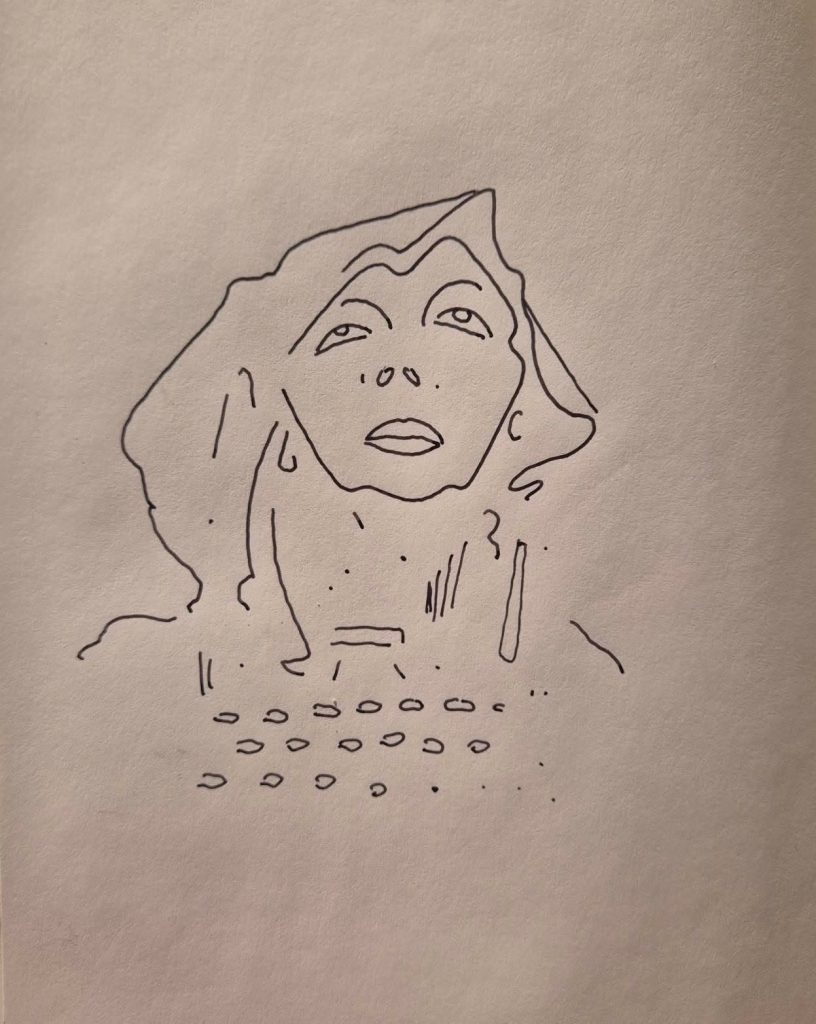
(Geta Brătescu by Hortensia Mi Kafchin)